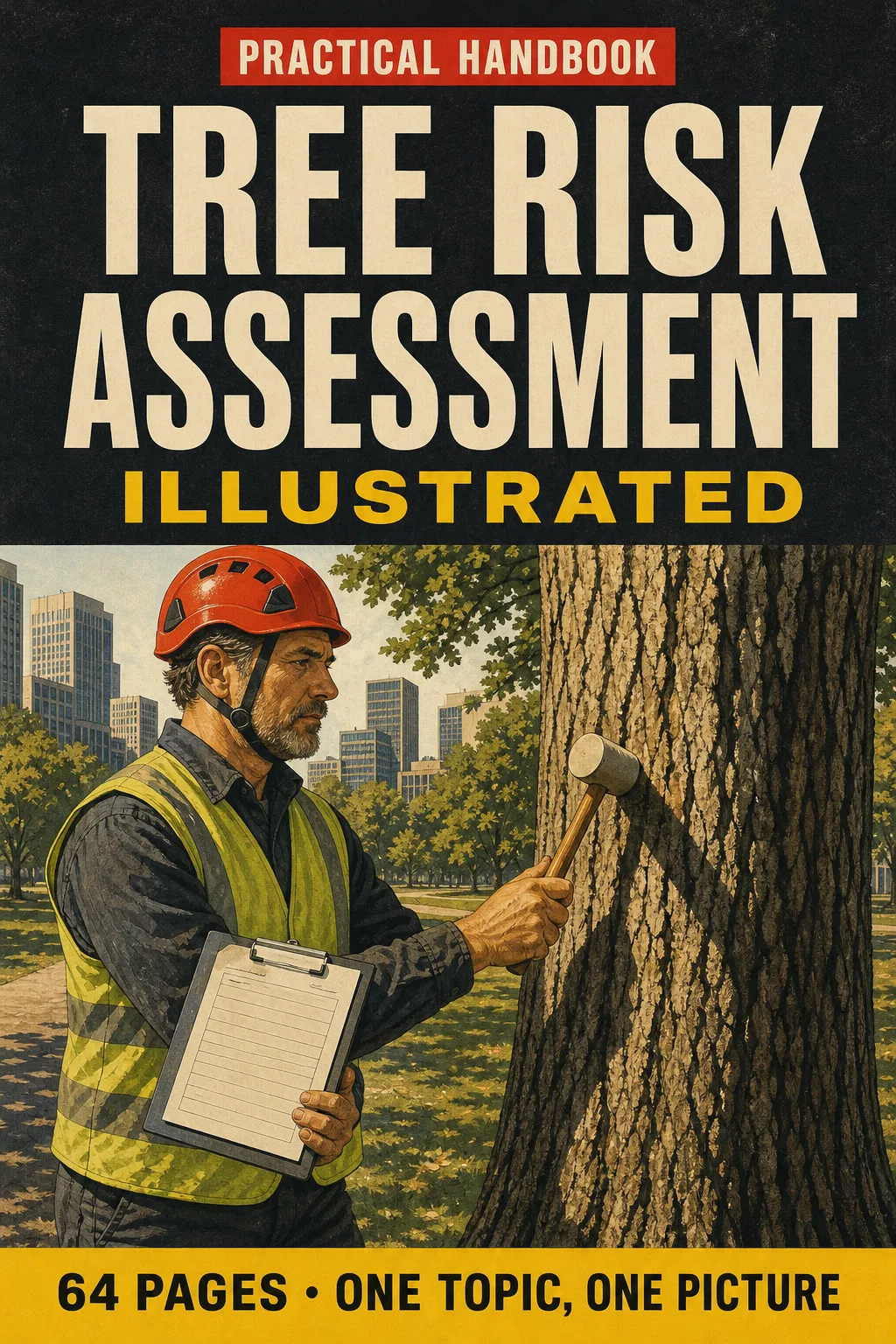
📄 Digital book in PDF · read it on your phone or print it
Targets and occupancy, tree health, codominant stems, cracks and decay, lean, likelihood of failure and impact, the two matrices, mitigation. Each topic gets its own page: the drawing first, then what you need to remember. 64 illustrated pages.
🔒 Secure checkout · PDF by email · 30-day guarantee
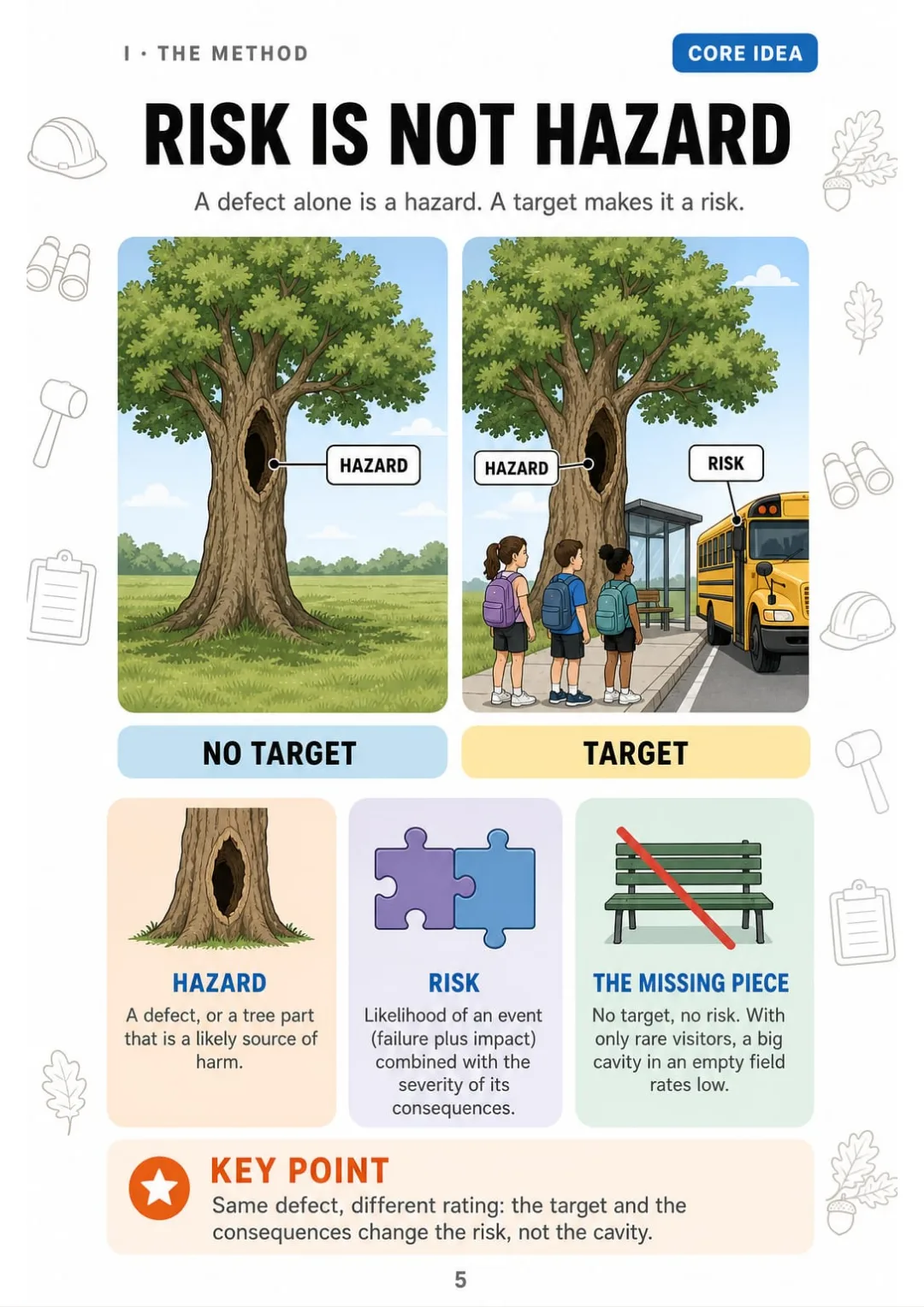
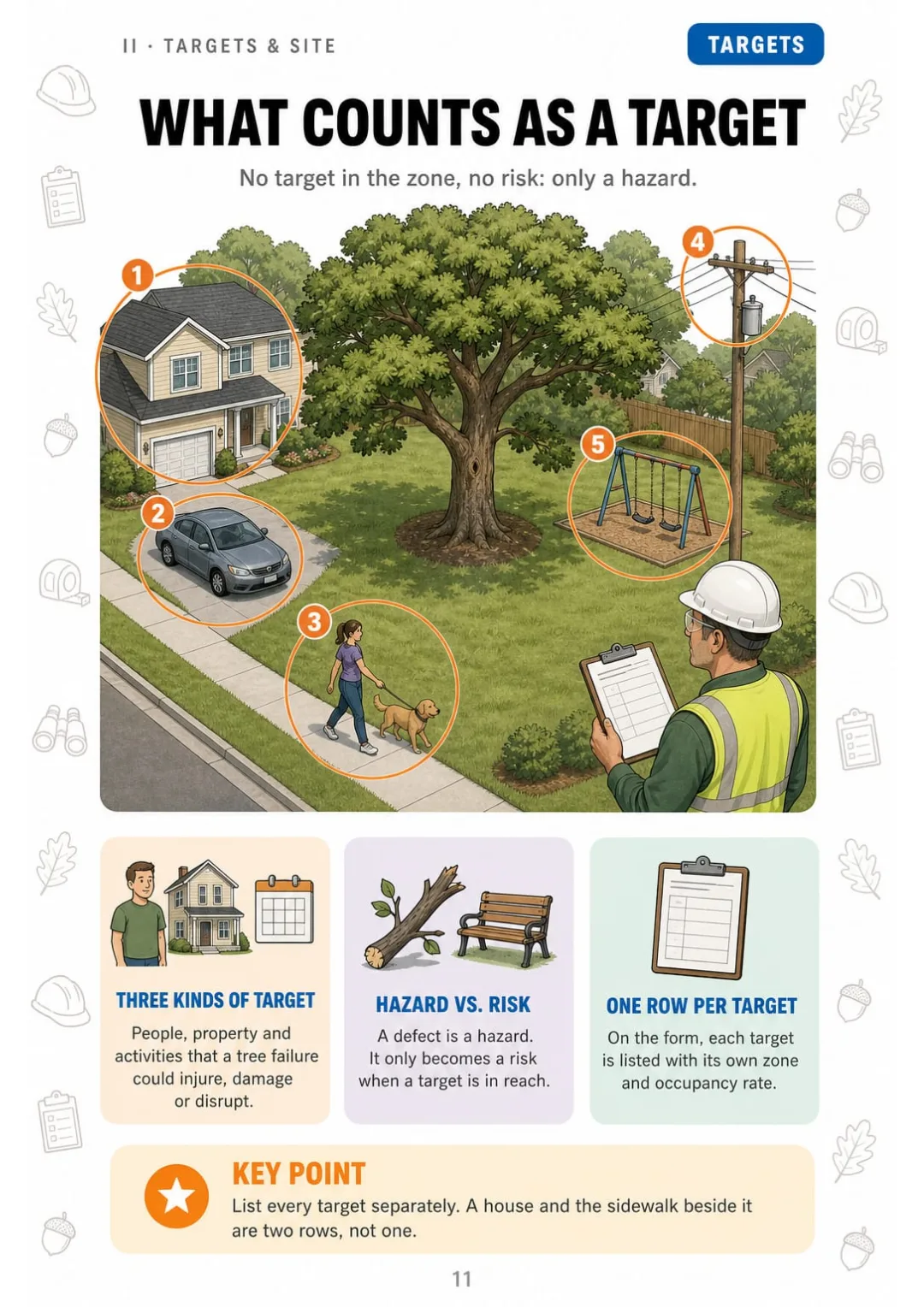
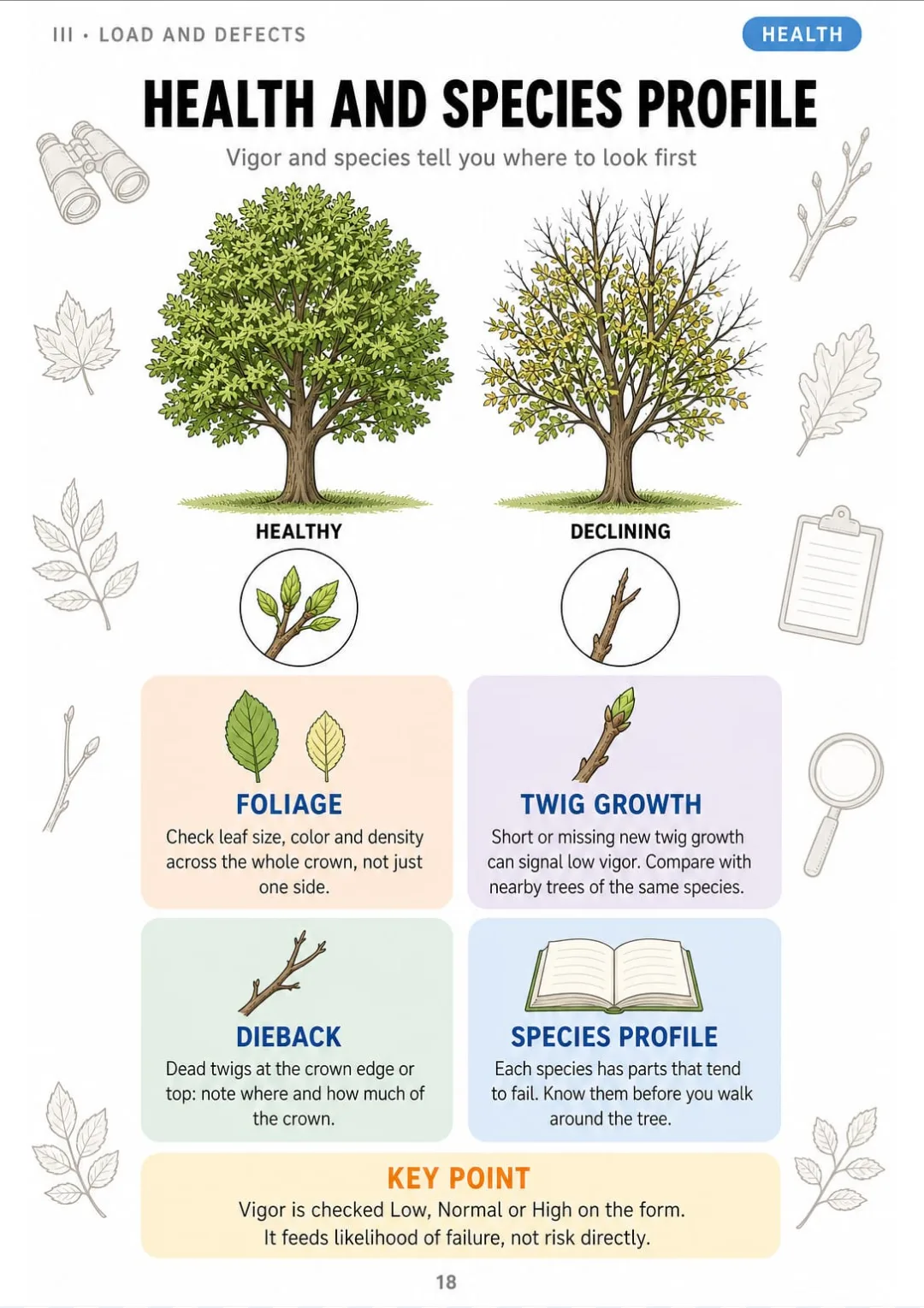
Every page has one big drawing and a box with the ratings and questions you need to know:


Swipe to see more →
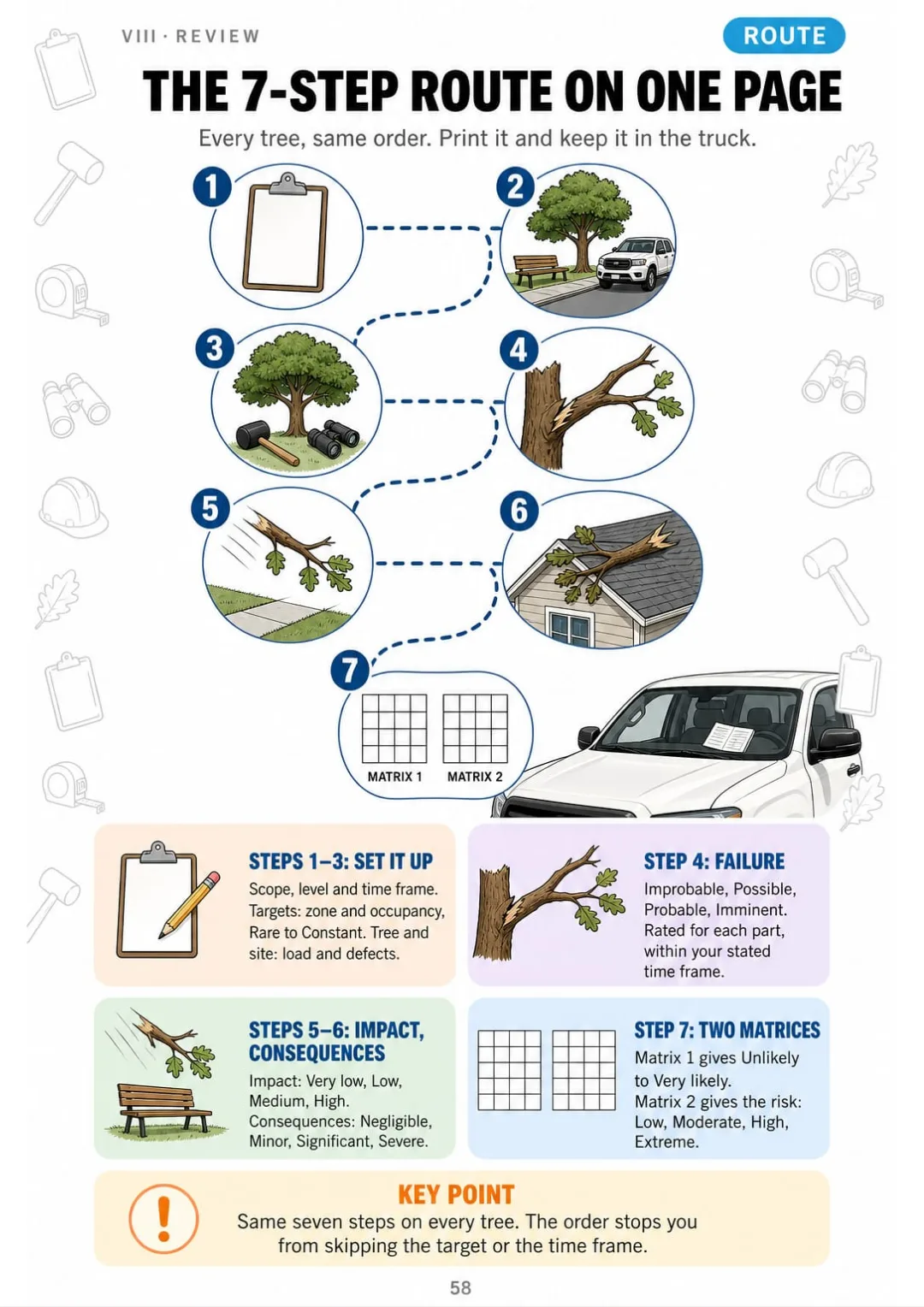
These are real pages from the book. The table of contents is the full one: 8 parts and 60 topics.
You're standing under a big silver maple over a parking lot. There's a cavity at the base and a seam running up the trunk. On the form: possible, or probable?
The manual defines the four likelihood-of-failure words in long paragraphs, with "normal weather" and the timeframe tucked in the middle. You read it, it made sense, and on the form the two middle words blur together.

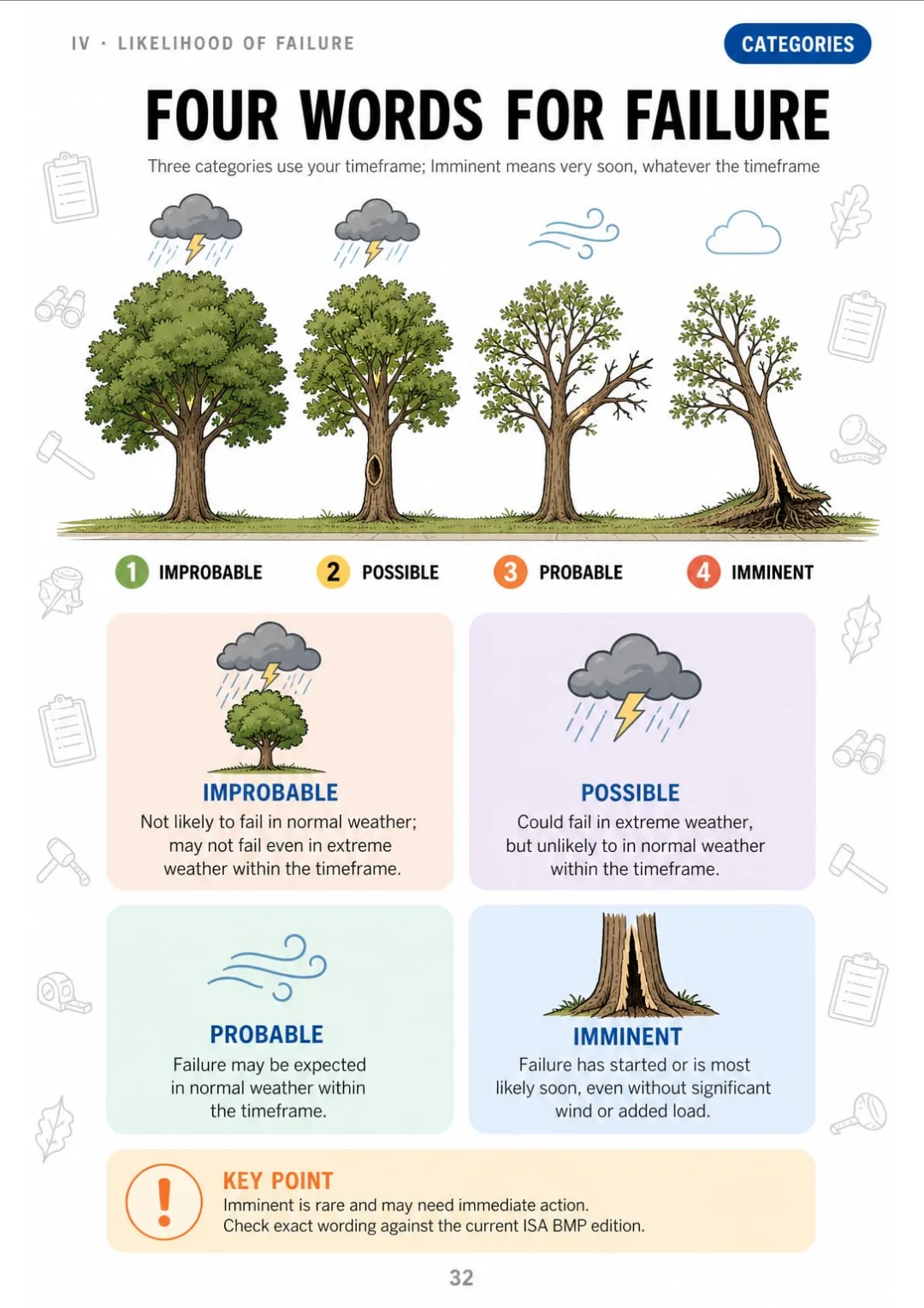
In the book, that's one page. The four likelihood-of-failure words drawn side by side: improbable, possible, probable, imminent, with the line between possible and probable marked: what you'd expect in normal weather, within your timeframe.
Same with targets and occupancy, codominant stems with included bark, decay and cavities, lean, and the two matrices. Each one gets its own page.
So you look at that seam, you know which word fits and why, and you write it on the form, ready to explain it if anyone asks.

The method, targets and the site, the tree and its defects, likelihood of failure, impact and consequences, the matrices, mitigation and the report, and a field review: 64 pages, all illustrated
Think of it this way:
A storm is coming, and the city wants a rating by Friday on a codominant oak over a school drop-off. You need the likelihood of failure right, and you need it on the form.
You open the page on codominant stems and included bark. The union is drawn with the bark pinched inside, the crack below it is marked, and the question to ask sits right beside it.

Same with the target zone, possible vs. probable, likelihood of impact, the two matrices and specific mitigation: each one on its own page.
Tree Risk Assessment Illustrated is 8 parts and 60 topics, all drawn, and it ends with a field checklist and a self-check where you rate 4 trees.
What you see drawn, you don't have to memorize.
Risk vs. hazard, the 7-step route (scope, targets, site, tree and defects, likelihood of failure, impact and consequences, matrices and mitigation), the three assessment levels, the basic form box by box, and what the standard says vs. what the BMP explains.
What counts as a target, the target zone, occupancy rates, moving vs. static targets, moving the target, site factors and construction damage.
Tree health and species profile, load factors, dead branches and hangers, codominant stems, cracks, decay, shell thickness, cankers, lean, roots, response growth and pruning history.
The four likelihood-of-failure words, the line between possible and probable, when it's imminent, rating the part, and how the timeframe changes it.
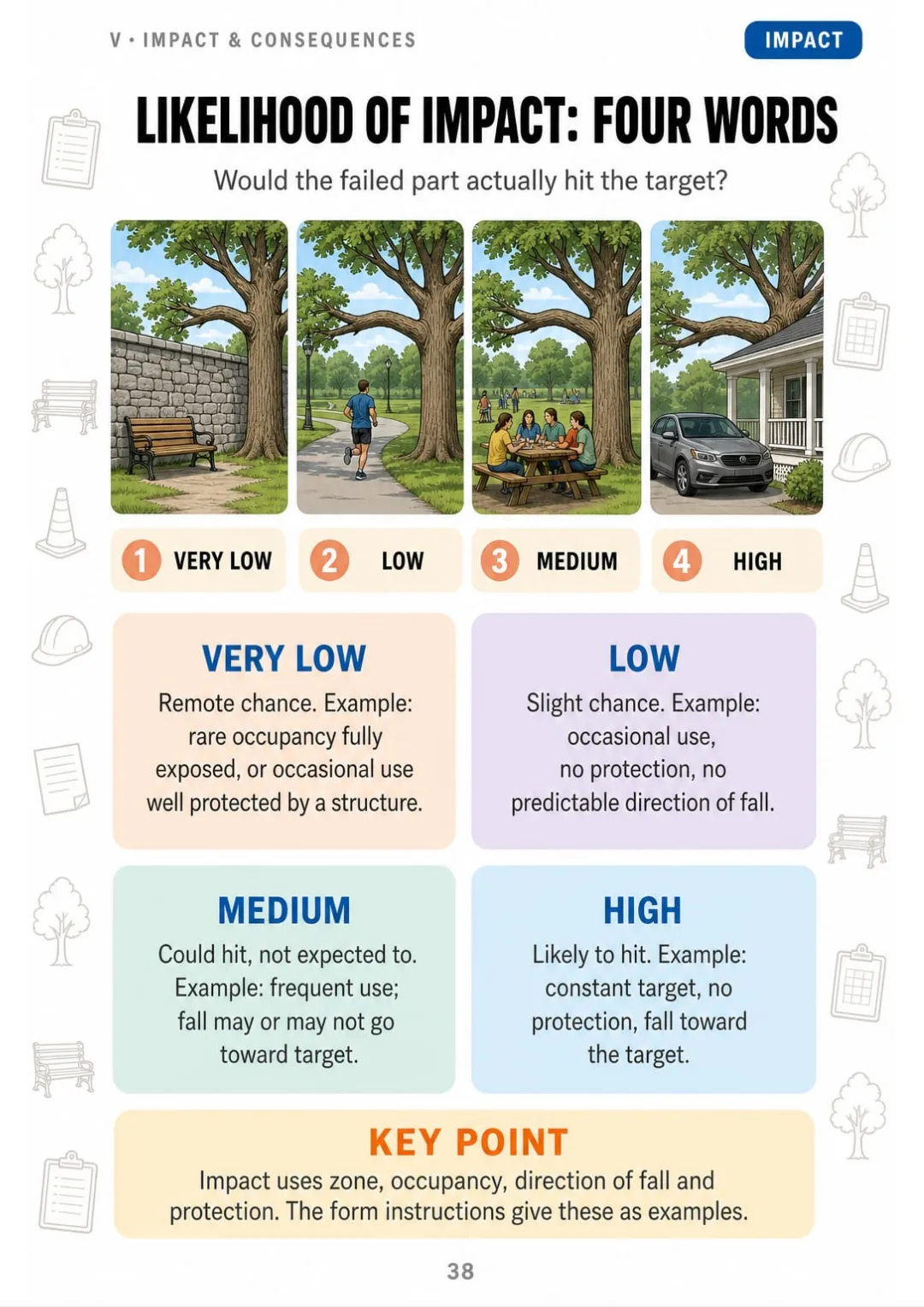
Likelihood of impact, direction of fall and protection, the four consequence levels, sizing the part, and power lines as a target.
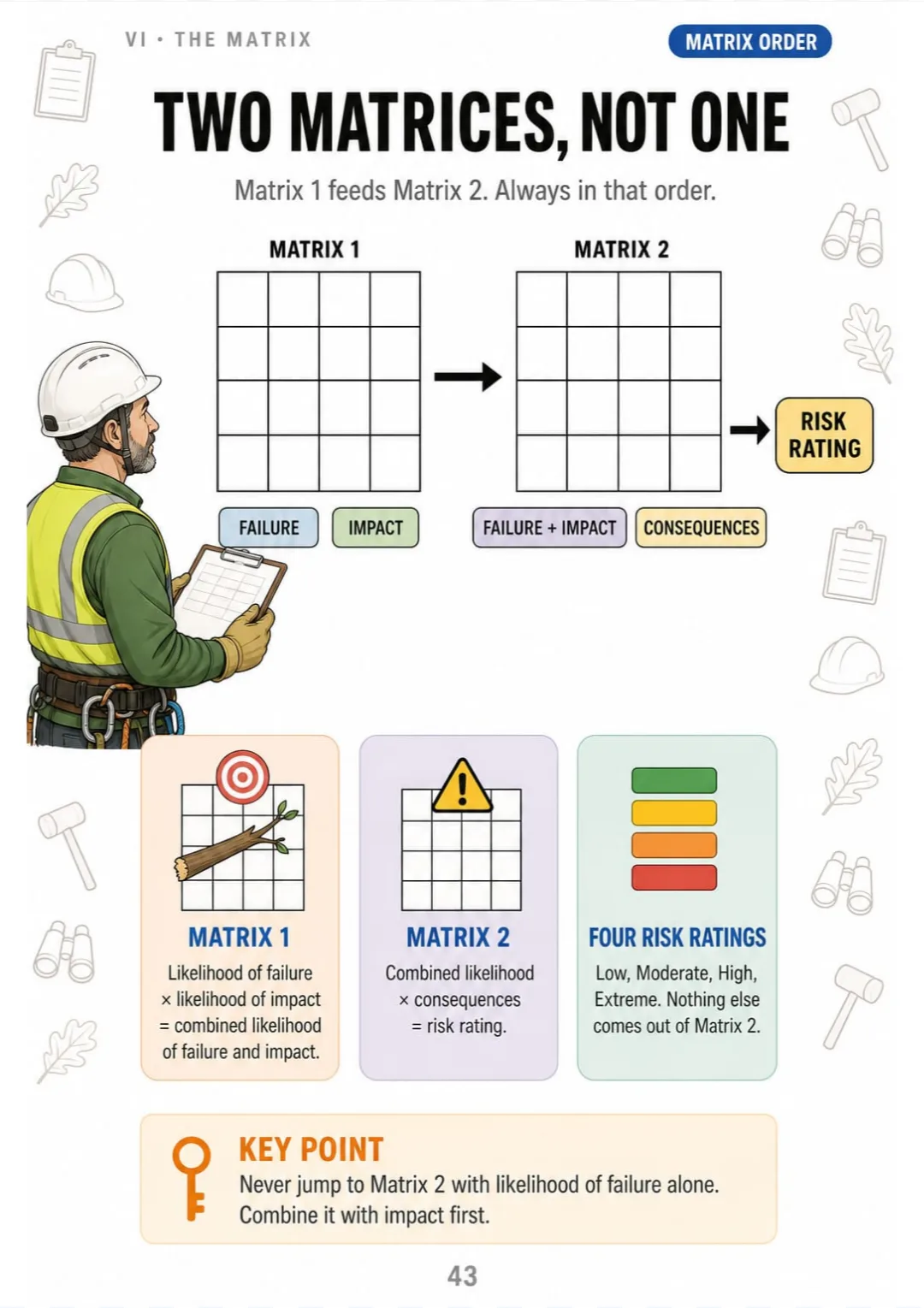
The two matrices walked with arrows, three worked examples (oak, maple, pine) and the overall tree risk rating.
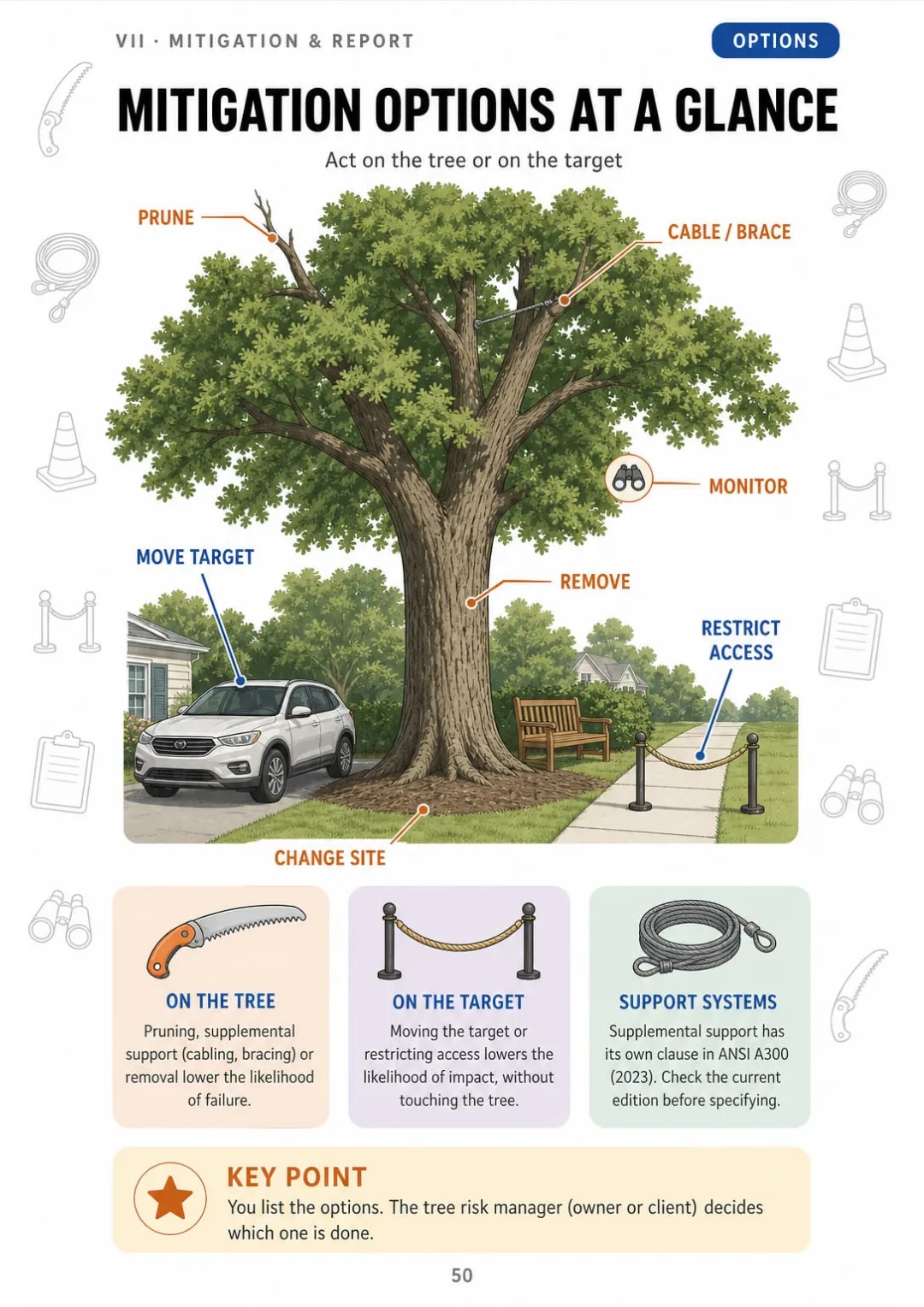
Mitigation options, residual risk, specific vs. vague recommendations, priority and reinspection, when to recommend an advanced assessment, and the written report.
The 7-step route on one page, rating vocabulary side by side, a defect checklist, frequent mix-ups on the form, a 4-tree self-check and field safety.
At the end of the book: The 7-step route on one page, a defect checklist, frequent mix-ups on the form and a self-check with 4 trees to rate.
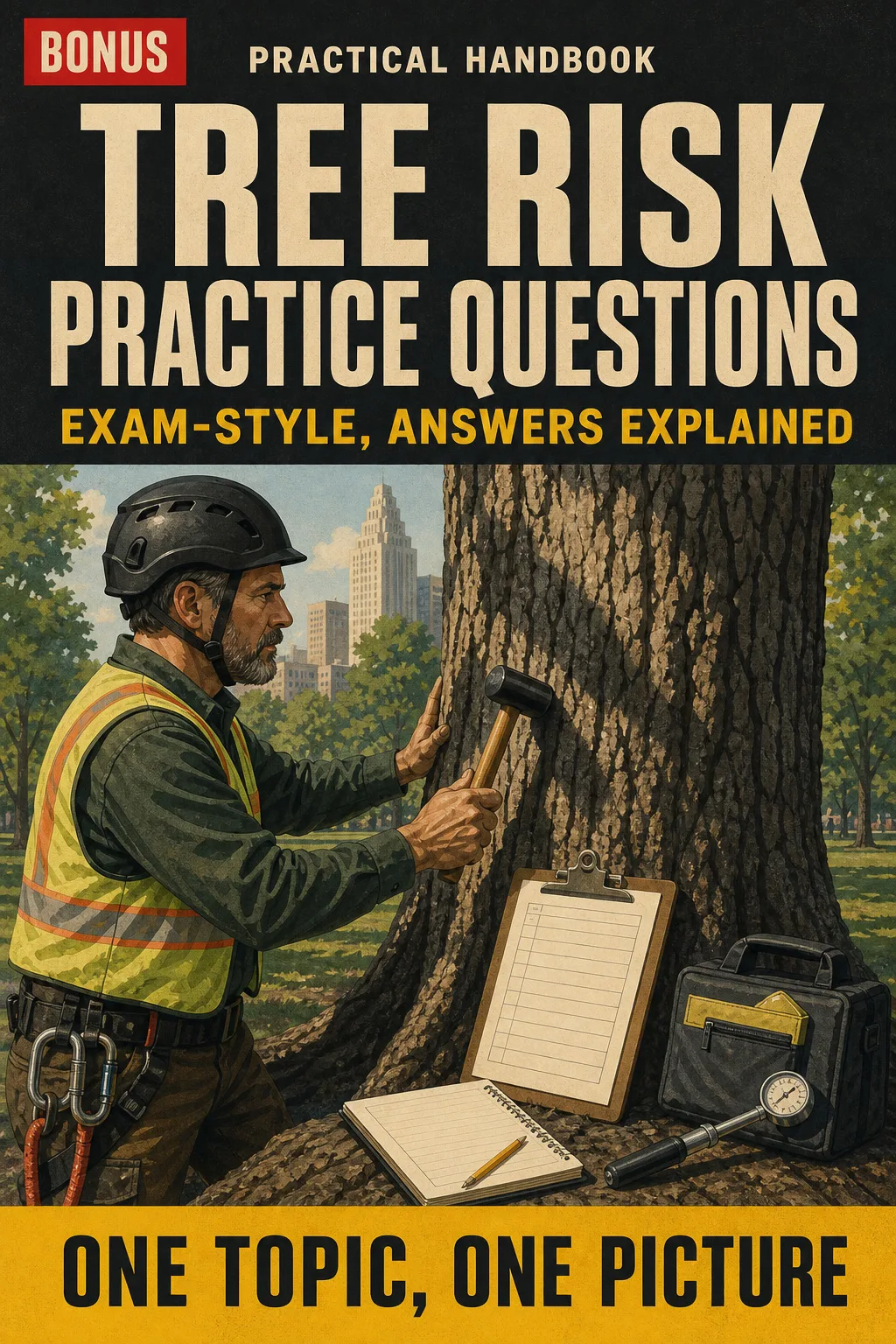
Test yourself with exam-style questions on targets, defects, likelihood and the matrix, and see why each answer is right, so you find your weak spots before the exam does.

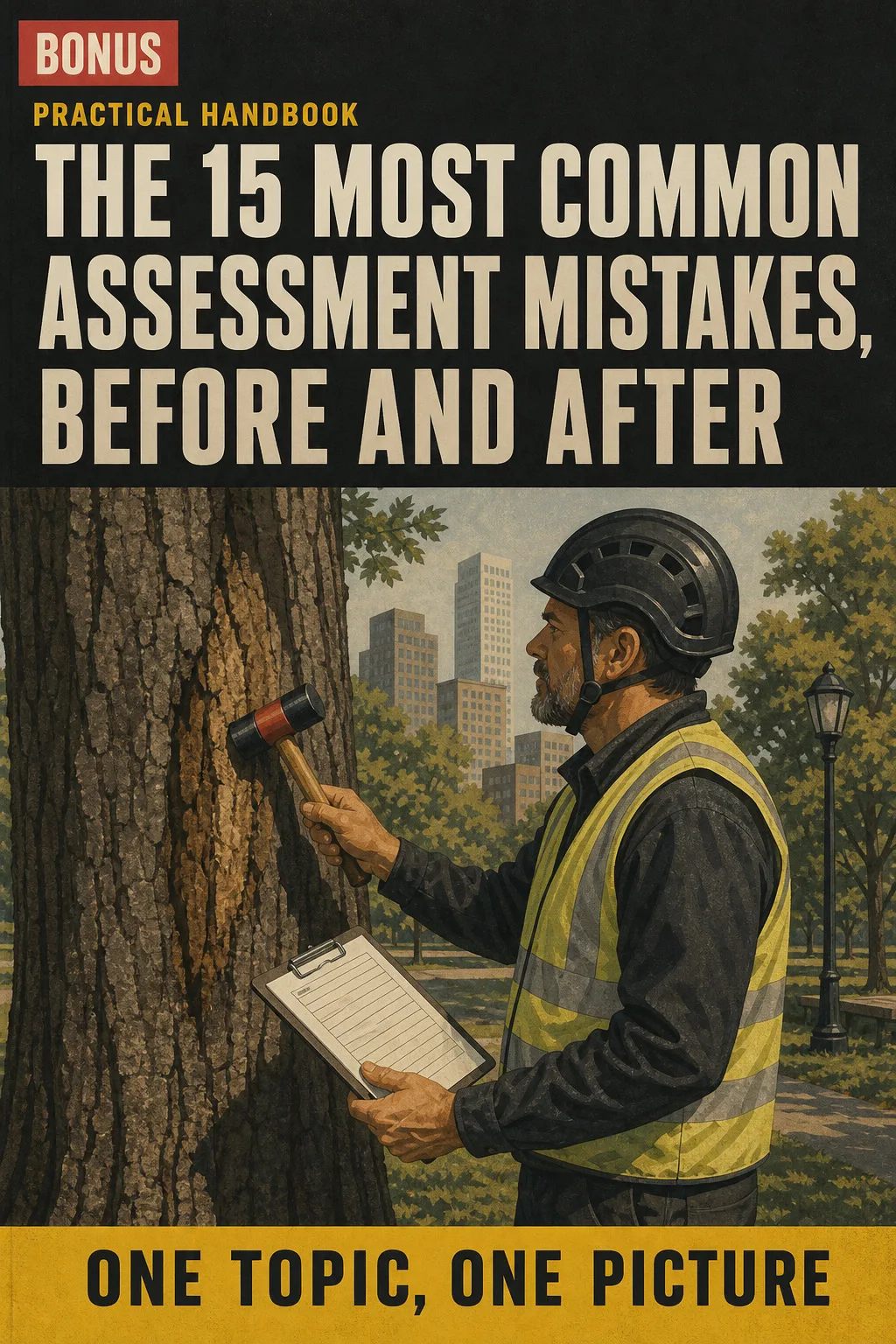
See the errors that show up most often on assessment forms (wrong likelihood, missed target, vague mitigation) drawn side by side with the corrected version, so you don't repeat them.
📄 This is a digital PDF book sent to your email: nothing is printed or shipped.
PDF by email: We email you Tree Risk Assessment Illustrated as a PDF, together with the two free books. It's a single payment: no installments, no extra charges.
You study in the same 7 steps you'll use in the field: scope, targets, site, tree and defects, likelihood of failure, impact and consequences, matrices and mitigation. One drawing per page.
You review the rating words and both matrices on a few pages, and check the frequent mix-ups on the form before test day.
You keep the 7-step route and the defect checklist printed in the truck, so every rating and report follows the same logic.
📄 This is a digital PDF book sent to your email: nothing is printed or shipped.
Try Tree Risk Assessment Illustrated for 30 days, bonus books included.
We refund everything if the file won't open, if the book isn't what you see here, if you were charged twice or if the email doesn't arrive. Just email us.
You pay once. No subscriptions.
Yes. It doesn't teach you trees: it puts the assessment method in a fixed order, with the rating words, the matrices and the report drawn page by page.
From the tree risk assessment part of ANSI A300 and the Tree Risk Assessment Best Management Practices, 2nd edition. Every reference shows its source, so you can check it against the current edition your course uses.
No. It's an independent study guide, not affiliated with or endorsed by ISA, ANSI or any certifying organization.
No. It's study material to go with the course. It doesn't give you a qualification, a certificate or CEUs, and it doesn't replace hands-on training, your professional judgment or an on-site assessment.
No. They're written for this book, in exam style, to help you find your weak spots. They are not official exam questions.
The book and the 2 bonus books arrive as PDFs by email, at the address you enter at checkout.
No. It's a one-time payment.
Yes. It's a printable PDF: print the whole book or just the pages you want to keep in the truck.
You have 30 days. We refund everything if the file won't open, if the book isn't what you see on this page, if you were charged twice or if the email doesn't arrive: just email us.
No more re-reading without it sticking.
Targets, defects and the matrix: you see them drawn, and that's it.
You walk into the course knowing where everything is.
Drawings make studying faster.
The book is right below.
One-time payment: US$ 27 · Guarantee: 30 days · PDF by email
YES, I WANT TREE RISK ASSESSMENT ILLUSTRATED FOR US$ 27📄 This is a digital PDF book sent to your email: nothing is printed or shipped.